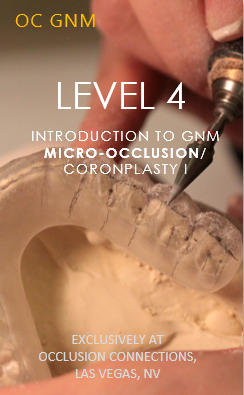
Course Description: "GNM Micro-Occlusion Mastery — Designing the Physiologically Optimized Occlusal Scheme with Hands-On Precision"
Teaching Method: Lecture and Participation
Prerequisite Course: Levels 1, 2, and 3
CE Credit Hours: 16
AGD Subject Code(s): 184 Occlusal Adjustment/Therapy | 180/185 Occlusion/Appliance Therapy | 010 Basic Sciences | 200 Orofacial Pain

Level 4 - GNM Micro-Occlusion Mastery
The Only Hands-On Micro-Occlusion Course of Its Kind in the World
Jump To: Micro-Occlusion Mastery | Hands-On Experience | Course Objectives | About Your Teacher | Testimonials
Are You Adjusting the Orthotic — Or Are You Truly Managing the Occlusion?
Most dentists who deliver orthotics know how to make adjustments. What very few know — and what no other program in the world teaches — is the systematic, anatomy-driven, physiologically-grounded approach that determines whether your orthotic cases stabilize or stall.
There is a profound difference between grinding on an orthotic and designing an occlusal scheme. Level 4 is where you learn that difference.
- When you adjust an orthotic, do you have a systematic, reproducible protocol — or are you removing material and hoping the patient feels better?
- Do you truly understand cusp-fossa relationships, incline planes, and mandibular movements well enough to design them intentionally — rather than accidentally grind them away?
- Can you land occlusal contacts precisely on a physiologically optimized trajectory — or are you working by feel and approximation?
- Do you know exactly when to coronoplast and when not to — and why getting that wrong can destabilize a case you have spent months building?
- Are you ready to take your orthotic management from adjustment to mastery?
If any of these give you pause — Level 4 was built for exactly this moment.
The lower anatomical GNM orthosis is the most powerful teaching tool in all of occlusion.
- See, feel, and measure exactly what your adjustments are doing in real time
- Follow Dr. Chan's systematic carving and shaping protocol — step by step
- Turn what once seemed impossibly precise into a reproducible clinical skill
By the time you leave — orthotic adjustment will never feel uncertain again.
.png)
No other program in the world offers this.
Two days. Your hands. Dr. Chan's protocols.
- Follow Dr. Chan's unique systematic anatomical occlusal carving system — step by step
- Establish centric stops and manage incline planes with precision and intention
- Remove torque and mandibular imbalances using Dental TENS
- Finalize and validate terminal contacts with jaw tracking and EMG technology
- Know exactly when Coronoplasty is indicated — and when it is not
Every skill. Every step. Every adjustment — done by you.
This is what two days with Dr. Chan produces.
Level 4 begins where no other course has ever gone — with your own hands on the orthotic from day one.
- Follow Dr. Chan's step-by-step micro-occlusal carving protocols on orthotic blanks
- Carve anatomical posterior occlusal form systematically and precisely
- Adjust each other's orthotics live — under Dr. Chan's direct guidance
- Then watch Dr. Chan demonstrate live — and see exactly what mastery looks like
This is the only course in the world where you develop true micro-occlusal hands-on mastery under Dr. Chan's direct guidance.
Level 5 is where you master the K7 and the Chan Optimized Bite. Level 4 is where you earn the right to go there.
After Level 4 — No More Guessing.
Most occlusal training gives you a position, a number, or a repeatable bite.
But is it physiologic? Is it unstrained? Is it objectively measurable?
- The hands-on ability to design, carve, and refine a truly physiologic occlusal scheme
- The objective instrumentation to measure and validate every contact in real time
- The systematic protocol that makes micro-occlusal mastery reproducible — every case, every time
This is not occlusal adjustment. This is occlusal mastery grounded in physiologic, unstrained, objectively measurable standards — and there is only one place in the world where you learn it with your own hands.
If you have ever wondered why your cases plateau — Level 4 is your answer.
Upon completion of this course, participants will be able to:
- Identify and classify occlusal prematurities and explain their clinical significance in occlusal management
- Apply Dr. Chan's systematic occlusal carving and shaping protocols to fabricate a lower anatomical GNM orthosis
- Establish cusp-fossa relationships, manage incline planes, and design centric stops for optimal occlusal function and stability
- Manage lateral excursive interferences without flattening the occlusal scheme
- Apply Dental TENS to remove torque and imbalances from the mandible during orthotic adjustment
- Utilize jaw tracking and EMG technology to finalize, balance, and validate terminal contacts objectively
- Determine when coronoplasty is indicated and when it is contraindicated
- Explain the role of anterior disclusion in occlusal stability and musculoskeletal health
- Apply micro-occlusal management principles to orthotic reline and adjustment procedures
- Integrate anatomical form design into comprehensive GNM treatment planning
- Steps to fabricate a lower anatomical removable orthosis following Dr. Chan's protocols
- How to make the anatomical orthosis comfortable and functional in the mouth
- Why anatomical form is crucial for proper craniomandibular and cervical function
- How to remove torque and imbalances from the mandible with Dental TENS
- How to manage the occlusal incline planes with precision and intention
- How to properly establish centric stops for optimal function and occlusal stability
- How to prevent flattening the occlusal surfaces and inadvertently grinding the bite
- How to manage lateral excursive interferences without flattening the occlusion
- Why the envelope of function is crucial to comfortable musculature and lasting esthetics
- How to finalize and balance terminal contacts with jaw tracking and EMG technology to measure and validate the quality of the bite
Clayton A. Chan, D.D.S. — Founder, Director, and Teacher
Occlusion Connections — The Center for Gneuromuscular Dentistry and Orthopedic Advancement

When taking OC's Masterclass training, you can be assured you are taught the most current and clinically relevant techniques — based on sound science, substantiated protocols, and proven clinical application. Dr. Chan's GNM teachings have afforded dentists from around the world the ability to implement clinical occlusal techniques that achieve outstanding results in real-world dental practices.
Dr. Chan's pioneering role in Gneuromuscular Dentistry — specifically his development of the systematic micro-occlusal carving and shaping protocols taught exclusively at OC — represents the most precise and clinically proven approach to orthotic management available in dentistry today. It is this hands-on mastery that makes Level 4 unlike any other course in the world.
"I waited a long time to take Level 4. I returned from the course on Sunday and this week my approach to adjusting orthotics was so different — in a good way — from before. I have delivered and adjusted many orthotics over the years and have had successful results, but this week the patients noticed the improvement in the bite much quicker. I highly recommend Level 4." — Janet Levine, D.M.D., Tarrytown, NY
"This was a course that I looked forward to greatly. It did not disappoint — it was better than I had hoped. This is most likely the course that I will apply more than any other. Dr. Chan demystified occlusion. He gives clarity to the subject. The focus on the anatomy and the advanced adjustment techniques make micro-occlusion and Coronoplasty an achievable, attainable goal. Thank you." — Stephen W. Durham, D.M.D., Beaufort, SC
"Watching Clayton adjust an orthotic is like watching an artist work in his favorite medium. My classmates brought so much insight and experience to the table and Clayton led the way — it was a terrific learning experience." — Bill Greenberg, D.M.D., Mount Holly, NJ
"What a mind shift. Amazing experience — so much hands-on. Felt like home with an amazing group of doctors. I am so much more confident to go back to my practice and finally resolve through this understanding — in just two days — how to resolve many of my patients not staying on trajectory." — Maria Escoto, D.D.S., Sunny Isles Beach, FL